Ballade’s Metrical Rules
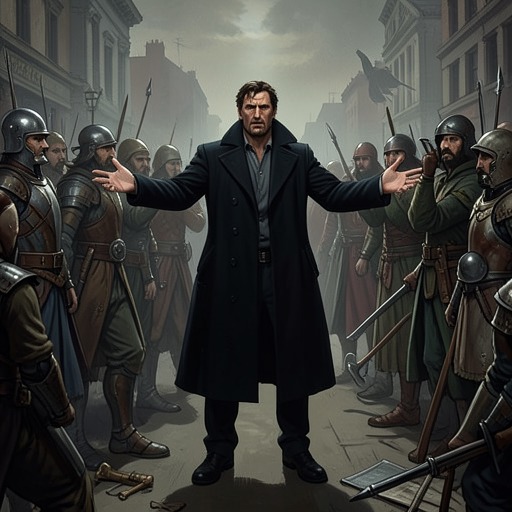
Cyrano de BergeracBallade’s Metrical Rules are presented as a compact formal scheme that Cyrano de Bergerac recites during his duel with the Viscount de Valvert. The form is more than a lesson: Cyrano makes its progression a clock for the fight, promising to meet the poem’s final line with a decisive touch.
The Stated Form
Cyrano gives the ballade’s structure while reciting as if repeating a lesson: “Three eight-versed couplets. . .” followed by “And an envoi / Of four lines. . .” His account establishes two parts—a sequence of three couplets and a four-line envoi—without specifying a rhyme scheme or a syllable count. Those details should not be inferred from the passage: the rule as stated is defined by its named units and their number.
The envoi is not an optional afterthought in Cyrano’s explanation. It completes the structure, and its position at the end gives the form a clear point of arrival. Cyrano singles out that endpoint when he says, “And touch you at the final line.” The formal description therefore supplies the terms of a challenge: the poem must reach its close, and the duel must reach its own decisive instant with it.
Form Turned into Action
Cyrano announces that he will make a ballade while fighting. As the duel proceeds, he does not separate verbal composition from physical performance: the stage direction says that he suits the action to each word. He begins by doffing his beaver, freeing hand and heel, and throwing off his heavy mantle. The poem’s unfolding is thus accompanied by visible preparation and movement, so the audience can follow the duel as both combat and a performance governed by a promised form.
At the close, Cyrano identifies the moment explicitly: “At the envoi's end, I touch.” He then declaims the envoi and moves into the action described in his verse. The structure has functioned as dramatic timing: Cyrano’s announced intention makes the final line a point of suspense, and his concluding touch fulfills the connection he established between the verse’s ending and the duel’s outcome.
Dramatic Significance
The exchange makes a formal rule legible through action rather than abstract explanation alone. Cyrano first recites the structure, then turns its ending into a public wager about what he can accomplish while composing and fighting at once. The progression from couplets to envoi gives the duel a verbal shape, while the repeated emphasis on the final line directs attention toward its culmination.
The evidence supports the structural counts Cyrano states and the way he stages them; it does not establish the ballade’s full technical prosody. The scene’s emphasis is instead on the form as a constraint Cyrano elects to perform under pressure. By binding the poem’s completion to his touch, he makes formal closure coincide with physical victory.